 NeuroAlarm
A math alarm clock you cannot answer half-asleep.
NeuroAlarm's Math challenge keeps ringing until you solve a ramp of arithmetic that gets harder every round. It is one of 11 mental challenges, from a Stroop test to a 4×4 Sudoku, each picked to need the part of your brain that is still switched off at 6 am.
Ring, solve, and only then silence.
1. Pick Math and a difficulty
When you create the alarm, choose Math and set how hard it should be. The same alarm can use a different challenge on different days, so Monday can be brutal and Sunday can be kind.
2. It rings with a ramp of problems
The ring screen takes over the lock screen and shows the first problem. Solve it and the next one is harder. Up to 10 rounds, with no swipe-away and no back button.
3. Wrong answers do not count
A miss simply keeps the alarm ringing. There is no penalty screen to game and no timeout that lets you off. The only exit is the right answers, in order.
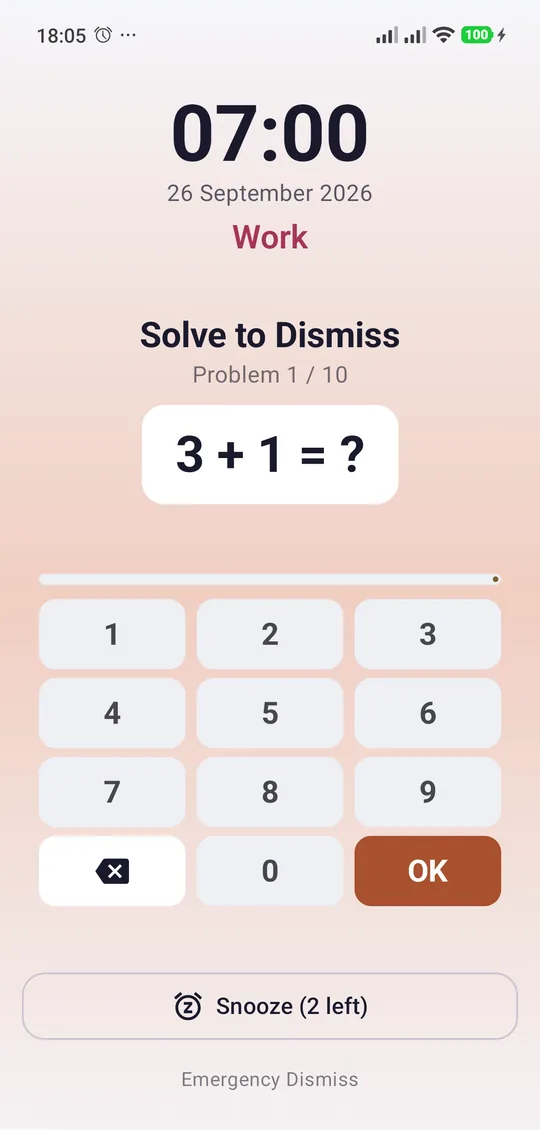
One easy question wakes nobody up.
Plenty of alarm apps ask you a single 7 + 5 and call it a math alarm. You can answer that with your eyes shut, and people do, then sleep for another hour. NeuroAlarm's Math challenge is a sequence: the first round is easy on purpose, so a groggy brain can get started, and each round after that needs more working memory than the last.
By round six or seven you are holding intermediate results in your head, which is exactly the cognitive load that sleep inertia cannot sustain. You either engage fully or you keep hearing the alarm. There is no third option.
Difficulty is yours to set. If you snooze too often on an alarm with adaptive anti-snooze on, the difficulty quietly ramps up on you.
Ten more ways to make your brain prove it is on.
Math is the best-known mental challenge, but it is not the only one, and for some people it is not the hardest. NeuroAlarm ships 11 mental challenges. All of them run on the phone and none of them need an internet connection.
The Stroop tests deserve a special mention. They measure exactly the thing sleep inertia damages most, inhibitory control, which is why they feel absurdly difficult in the first minute after waking and trivial ten minutes later. If Math has become routine for you, switch to Stroop for a week.
An honest caveat. Mental challenges wake your brain, but they do not force you out of bed. Some people solve a Sudoku and go straight back to sleep. If that describes you, do not choose between a math alarm and a physical one; use both. A compound alarm chains a physical challenge, such as the 100 m walk or a QR scan in the bathroom, with a mental one, so you have to get up first and think second.
As with every NeuroAlarm challenge, nothing is recorded or sent anywhere. There is no account, no ads and no analytics. See the privacy policy.
Math alarms, answered.
You choose the difficulty when you set the alarm. The challenge is a ramp of up to 10 rounds that starts easy and gets harder as you go, so even the low setting ends with problems you need to think about. Pick a level you can do awake but not asleep.
Not usefully. A wrong answer does not end the ring, and the alarm keeps sounding until the whole ramp is solved. Guessing through several rounds takes longer than working them out, and by then you are awake anyway. If you want something that cannot be gamed at all, chain Math with a sensor-verified physical challenge in a compound alarm.
Often not. Mental challenges switch the brain on, but some people solve them and fall straight back asleep. If that is you, use Math as the second half of a compound alarm after Walk Distance, Stair Climb or Squats, so you have to get up first and think second.
Math, Memory Sequence, Stroop, Number-size Stroop, Arrow Flanker, Pattern, Reaction Time and Mini Sudoku are language-free by design and work anywhere in the world. Anagram, Captcha and Trivia use text.
Math is free forever, along with Squats and Quick Alarm, with no ads. The other 18 challenges are part of NeuroAlarm Pro: monthly, yearly with a 7-day free trial you can cancel at any point, or a one-time lifetime purchase, billed by Google Play.
Brain on before feet.
Free to install, no account, no ads. Math, Squats and Quick Alarm are free forever; every other challenge is yours to try free for 7 days.