 NeuroAlarm
The walk to dismiss alarm that checks you actually walked.
NeuroAlarm's Walk Distance challenge keeps ringing until the phone's GPS confirms you are 100 metres from where you woke up. Not steps shaken out under the duvet. Not a fake-location app. Real distance, outside, on your feet.
Three steps between the ring and silence.
1. It rings and takes the screen
At the set time the ring screen appears over the lock screen with the Walk challenge already running. There is no swipe-away and no back button out of it.
2. GPS measures from your start point
The first fix marks where you stood. The counter climbs only as your straight-line distance from that spot grows, so pacing the bedroom gets you nowhere.
3. At 100 m it stops, cleanly
Hit the distance and the alarm ends on the spot. No lingering notification, no second ring. You are outside, upright and awake, which was the whole idea.
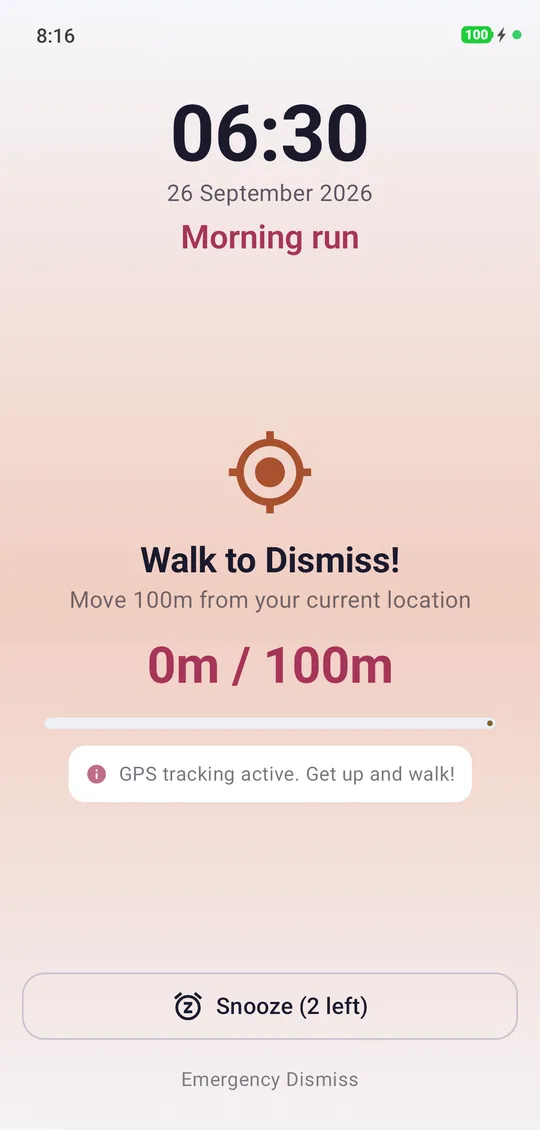
A distance counter, and nothing that lets you off early.
The ring screen shows one number: metres walked out of 100. It updates as fixes arrive and nothing else on the phone is reachable until it is done. Open the app from the launcher mid-ring and it bounces you straight back to the challenge.
100 metres is deliberate. It is short enough to be fair on a cold morning, but long enough that you have put on shoes, opened the front door and got fresh air on your face. By then the sleep inertia that makes snoozing feel reasonable has mostly worn off. Want more? Run Distance lets you set a longer target and rejects car-like speeds.
Prefer to stack the odds? A compound alarm chains Walk with a mental challenge such as Math or Stroop, so you need your legs and your brain before it goes quiet.
Built for the version of you that will try anything at 6 am.
Mock-location rejection
Fixes from Android's mock provider, fake-GPS apps and root modules that spoof position are discarded. The counter stays at zero until real satellites say otherwise.
Displacement, not motion
Distance is measured from the starting point, not accumulated from every wobble. Shaking the phone or circling the kitchen does not add metres.
Same family, same standards
Stair Climb cross-checks the barometer against your step count so an elevator ride fails. Run rejects vehicle speeds. Every physical challenge assumes you will try to cheat it.
If dismissing the alarm has never once meant you were up.
Most alarm apps confuse turning the alarm off with getting out of bed. For a lot of people those are two different events separated by forty minutes of drifting back to sleep. An alarm that makes you walk closes that gap, because you cannot be 100 metres down the road and still horizontal.
- Heavy sleepers who have solved math alarms and shaken shake alarms without ever fully waking up.
- Early trainers and commuters who need to be out of the door at a fixed time and want the alarm to double as the first 100 metres of the day.
- Anyone with a snooze habit who wants dismissal to cost something real, not a swipe.
It is not the right pick for every situation. If you live somewhere GPS is weak indoors and stepping outside at 6 am is not practical, use Step Count or the QR code challenge, or use the Walk challenge only on weekdays and something gentler at the weekend. NeuroAlarm lets you set a different challenge per alarm, so you can be as strict as your Monday needs and no stricter.
Everything about the challenge runs on the phone. Your GPS position is used live to compute distance, never stored, never uploaded. There is no account and no analytics. Read the privacy policy if you want the specifics.
Walk to dismiss, answered.
Not reliably, and that is the point. GPS needs a view of the sky, and 100 m of straight-line distance from your bed almost always means leaving the building. If you cannot go outside in the morning, pick Step Count (reads the phone's step sensor, works anywhere) or put a QR code in the bathroom and use the QR Scan challenge instead.
No. Fixes coming from Android's mock-location provider, fake-GPS apps and root modules that spoof position are discarded, so the distance counter simply does not move. The Run challenge additionally rejects vehicle speeds, so a drive does not count as a jog either.
Every ringing alarm has an Emergency Dismiss. You type out a short accountability phrase and the alarm stops. It is deliberately slower than a swipe so it never becomes a habit, but it is always there for the mornings where walking outside genuinely is not an option.
No. Distance is computed on the device from live GPS fixes and only the number of metres walked is kept for the duration of the ring. Your position is never written to storage and never leaves the phone. NeuroAlarm has no account, no ads and no analytics SDK.
Quick Alarm, a plain tap-to-dismiss alarm, and the Math and Squats challenges are free forever with no ads. Walk Distance and the other Pro challenges are part of NeuroAlarm Pro: monthly, yearly with a 7-day free trial you can cancel at any point, or a one-time lifetime purchase, billed by Google Play.
Tomorrow, walk it off.
Free to install, no account, no ads. Quick Alarm, Math and Squats are free forever; Walk Distance and every other challenge are yours to try free for 7 days.